


The US under Trump administration has agreed to release $6 billion of Iranian oil revenues held in Qatar, allowing Tehran to use the funds exclusively to purchase American agricultural and medical products. In a Truth Social post on Tuesday, Trump said the money would be spent on “corn, wheat, and soybeans from our great American Farmers” as well as food and medical supplies, framing the release as a humanitarian necessity. A person briefed on the talks said the funds would be released in phases tied to progress in future negotiations, with a further $6 billion potentially available under the same framework if Iran spends the initial tranche and talks advance.
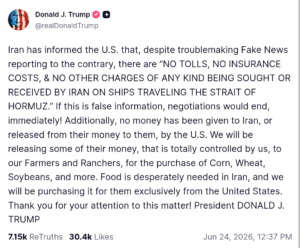
The release is part of a broader package of concessions and incentives tied to the ceasefire extension signed last week, which extended the April 8 ceasefire by 60 days and established a framework for reopening the Strait of Hormuz and negotiating Iran’s nuclear programme. Hours after the first round of high-level talks concluded in Switzerland on Monday, the US Treasury issued a waiver allowing Iran to sell oil — including in US dollars — until August 21.
What Was and Was Not Agreed on Nuclear Inspections
The nuclear dimension of the talks produced conflicting accounts from both sides almost immediately. US Vice President JD Vance, who led the American delegation, said Iran had agreed to invite International Atomic Energy Agency inspectors back into the country. Trump went further on Truth Social, claiming Iran had “fully and completely agreed to highest level Nuclear inspections long into the future.”
Iran’s foreign ministry told a different story, stating that Tehran “did not engage in negotiations regarding the nuclear file during the 18-hour talks and did not accept any new commitments.” A person briefed on the discussions offered a middle position — that Iran had agreed to invite IAEA inspectors and explore future cooperation, without committing to specific terms.
The gap matters. Iran’s 440 kilograms of uranium enriched close to weapons-grade levels is believed to be located beneath the rubble of the Natanz, Fordow and Isfahan nuclear facilities, which were severely damaged during US bombing last year. Iran has not permitted inspectors access to any of those sites. The two sides also agreed to establish a deconfliction cell to halt fighting between Israel and Hezbollah in Lebanon, which has been threatening to derail the broader peace process.
A Deal Built on Phases and Ambiguity Has a Short Shelf Life
The structure of what has been agreed deserves scrutiny. The $6 billion is released in phases. The ceasefire extension runs 60 days. The oil sales waiver expires August 21. Nuclear inspection access remains contested between the two governments’ public statements. Every significant element of this arrangement has a built-in expiry date or a disputed interpretation, which means the current period of relative calm is less a resolution than a structured pause.
From a markets perspective, the reopening of the Strait of Hormuz is the variable that matters most in the near term. Oil prices and bond yields have both been pricing in an extended closure — any credible progress toward restored shipping will move those numbers quickly. The phased release of funds tied to negotiating progress gives the US leverage to slow or halt the process if Iran stalls on nuclear access, but it also means the market cannot price in a clean resolution.
What is being constructed here is not a deal — it is a framework for making one, with financial incentives designed to keep Iran at the table long enough for something more permanent to emerge. Whether that something materialises before the 60-day clock runs out is the question every oil trader, airline CFO and central banker is now watching.
