

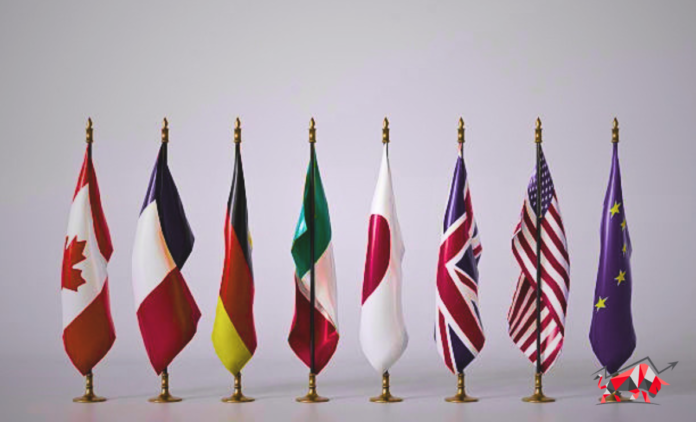
French President Emmanuel Macron announced on Friday he would convene a G7 summit focused on coordinating releases from G7 strategic oil reserves, as the Middle East conflict continues to destabilise global energy markets. Brent crude surged to nearly $110 a barrel this week before pulling back to around $104 on Friday, with the latest price spike driven by an attack on a Saudi oil pipeline connecting eastern production facilities to a western export terminal.
“I will convene a G7 to make progress on better coordination regarding stock levels, with greater cooperation also on exports and production capacities,” Macron said.
The announcement comes as the pace of existing strategic reserve releases has slowed significantly. Of the 400 million barrels agreed in March in what was the largest strategic release in the International Energy Agency’s history, 320 million had been released by August. The remainder is entering global markets at what officials describe as a trickle. Most of what has been released so far has come from US crude supplies. Europe has yet to deploy significant portions of its own refined fuel stockpiles, despite being the region most exposed to the current supply disruption.
A Gas Crisis Compounding the Oil Problem
Macron also announced he would contact European Commission president Ursula von der Leyen to coordinate a bloc-wide response on natural gas, specifically focused on increasing storage levels heading into winter. Europe is entering the winter season with record-low gas storage, a situation that has developed as the Iran war disrupted Middle Eastern supply routes that European nations had been relying on following their pivot away from Russian energy after Moscow’s invasion of Ukraine.
Normally, EU countries draw on gas held in storage to supply approximately one-third of their fuel needs during winter months. With storage at record lows and import routes under pressure, the coming months carry a level of energy risk Europe has not faced since the immediate aftermath of the Russia-Ukraine escalation. “Exceptional times call for exceptional measures,” Macron said. It is currently unclear whether the G7 or the IEA would take the lead in coordinating any further reserve releases if leaders agree to proceed. According to the IEA’s latest tracking data, member country reserve levels have declined materially since the March coordinated release. For more on how the Iran war has reshaped Europe’s energy vulnerability, see our report on Gulf states racing to build pipeline alternatives to the Strait of Hormuz.
G7 Strategic Oil Reserves Cannot Solve a Supply Problem, Only Delay It
We need to be direct about what strategic reserve releases actually do, because the political framing around them tends to overstate their impact. Reserves are a buffer, not a supply source. They buy time for markets to adjust, for alternative suppliers to ramp up, and for diplomacy to work. They do not replace the roughly one-fifth of global oil that normally moves through the Strait of Hormuz, and they cannot be released indefinitely.
The fact that 320 million of the 400 million barrels agreed in March have already been deployed, with the conflict still unresolved and Brent still trading above $100, tells us that the buffer is being consumed faster than the underlying problem is being solved. A second round of G7 coordinated releases, if agreed, would provide another short-term price cap.
But Europe entering winter with record-low gas storage and continued uncertainty over Middle Eastern supply routes is not a problem that strategic reserves can fix. Macron is doing what leaders do in a crisis, convening meetings and coordinating responses. What the market actually needs is a resolution to the conflict that reopens the Strait of Hormuz at scale. Until that happens, every reserve release is just a smaller version of the same temporary patch.
