

The Iran war has forced Gulf oil exporters to confront a vulnerability they have long tried to avoid addressing. With the Strait of Hormuz — the narrow waterway through which roughly one-fifth of the world’s oil normally passes — now under effective Iranian control, producers are revisiting expensive and politically complicated plans to build pipeline routes that bypass it entirely.
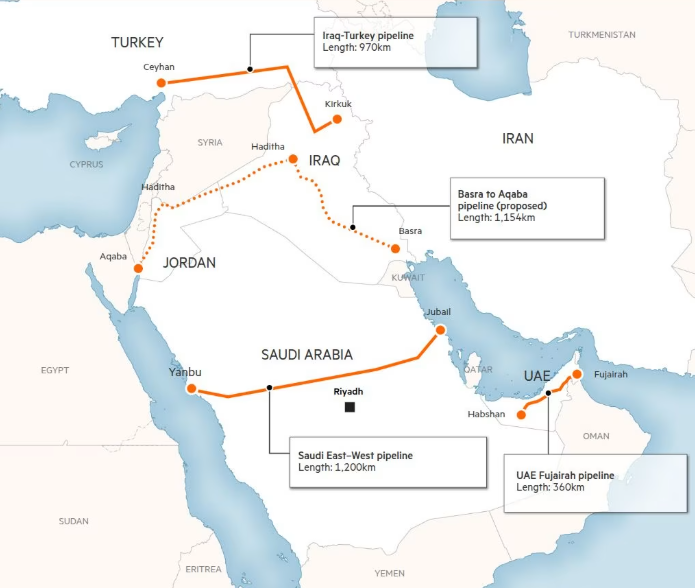
The most immediate evidence of what good infrastructure planning looks like comes from Saudi Arabia’s 1,200km East-West pipeline, built in the 1980s following the Iran-Iraq tanker war. It now delivers up to 7 million barrels of oil a day to the Red Sea port of Yanbu, completely avoiding Hormuz. Saudi Aramco CEO Amin Nasser recently confirmed it is “the main route we are capitalising on right now”. One senior Gulf energy executive called it, in hindsight, “a genius masterstroke.” Saudi Arabia is now examining whether to expand its capacity further or build additional export terminals on its Red Sea coast, including at the deepwater port under construction for the Neom project.
The Options Are Real, The Obstacles Are Larger
Beyond expanding existing infrastructure, the most discussed alternatives involve multi-country pipelines—from Iraq through Jordan, Syria, or Turkey— that would cost between $15 billion and $20 billion to build, according to Christopher Bush, CEO of Cat Group, the private Lebanese firm that helped construct the original East-West pipeline. Even replicating that pipeline today would cost at least $5 billion, he estimates.
Other proposals include reviving the US-backed IMEC corridor, an ambitious trade route that would run from India through the Gulf to Europe, though part of that project originally involved a politically sensitive pipeline terminating at the Israeli port of Haifa. Abu Dhabi is also reported to have maintained contingency plans for a second pipeline to its Fujairah port, which sits outside the strait. Yossi Abu, CEO of Israeli company NewMed Energy, said he was confident pipelines to the Mediterranean would eventually be built. “People need to control their own destinies, with their friends,” he said.
But the practical barriers are significant. Iraq, one of the key transit countries in several proposals, has large quantities of unexploded ordnance and an active militant threat from ISIS. Routes running south through Oman face difficult desert and mountain terrain, and Oman’s key port of Salalah was itself temporarily shut after recent drone attacks — a reminder that no alternative route is entirely beyond Iran’s reach. Beyond the physical challenges, Bush noted that a pipeline network crossing multiple countries would require Gulf states to “abandon their individualist policies and combine” — something the region has historically resisted.
A Problem That Won’t Be Solved Before This Crisis Ends
Senior energy advisers tracking the region say the mood has shifted. Maisoon Kafafy, a senior adviser at the Atlantic Council’s Middle East programmes, said discussions have moved “from hypotheticals into operational reality”. She added that she does not expect the pre-conflict status quo to return and that the most resilient long-term solution would be “not a single alternative pipeline but a network, a web of corridors” — though she acknowledged it would also be the hardest to achieve.
The UK is currently leading talks among 35 countries aimed at forming a coalition to reopen the strait. No decisions on new pipeline investments are expected until the long-term status of Hormuz becomes clearer.
The hard reality is that the infrastructure capable of reducing Gulf countries’ dependence on the strait would take years and tens of billions of dollars to build — none of which helps the refineries, airlines and economies absorbing the cost of this crisis right now. The East-West pipeline exists because someone built it decades ago in anticipation of exactly this scenario. The lesson from this conflict may simply be that the Gulf needed to build more of them sooner and that the window to do so cheaply and without urgency has now closed.
This report is based on information from The Financial Times.
