


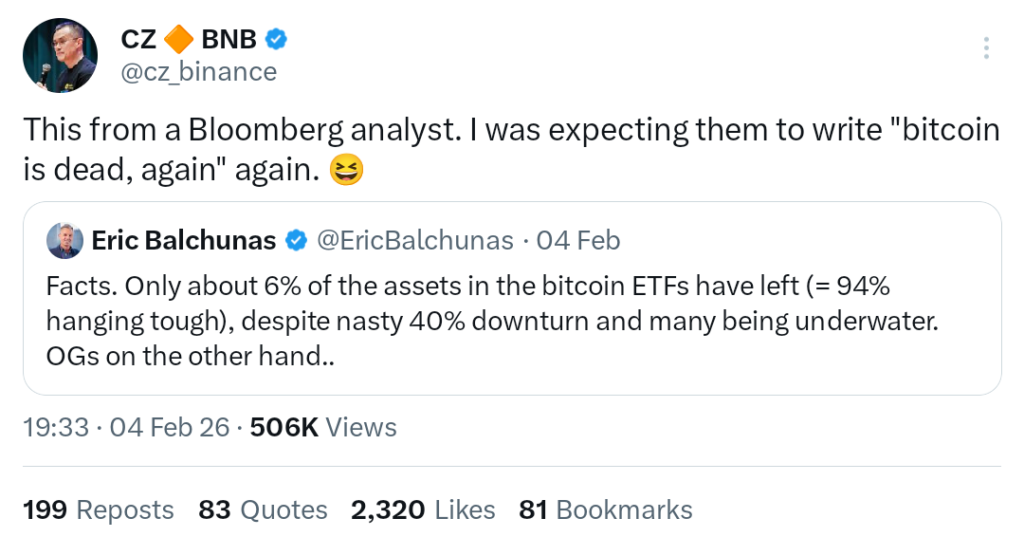
“I was expecting them to write ‘bitcoin is dead, again’ again,” joked Changpeng Zhao, Binance’s founder, responding to Bloomberg ETF analyst Eric Balchunas’s latest observation about Bitcoin ETF holders. CZ’s comment captures the absurd predictability of crypto bear market narratives—every downturn triggers the same obituaries, the same doomsday predictions, and the same declarations that this time is different and Bitcoin has finally died.
Except the data tells a completely different story. Despite BlackRock’s IBIT experiencing record trading volume exceeding $10 billion in notional value as prices plunged 13% to below $35, and despite the average ETF holder now sitting on losses approaching $11 billion, something remarkable is happening: they’re not selling.
The 94% Who Refused to Panic
IBIT hit $100 billion in assets for a brief moment, which marked the market top, before declining to $60 billion. That represents a 40% drawdown in the fund’s value. Yet according to Balchunas, only about 6% of assets in Bitcoin ETFs have left, meaning 94% are hanging tough despite the nasty 40% downturn and many being underwater.
The composition of sellers versus holders reveals the real story. The selling pressure hasn’t come from ETF investors—it’s come from original Bitcoin whales, the OG holders who accumulated years ago at much lower prices. ETF buyers, by contrast, are demonstrating what crypto veterans call “diamond hands”—refusing to sell despite mounting paper losses.
Jim Bianco of Bianco Research pointed out that the average Bitcoin ETF investor is now roughly 24% underwater, with unrealized losses approaching $11 billion. Multiple data sources confirm this painful reality: Bitcoin spot ETF investors paid an average of roughly $90,200 per bitcoin, and with the cryptocurrency trading around $76,800 to $79,000, they face paper losses of 8 to 9%. Some estimates put 62% of total bitcoin ETF inflows now underwater.
For context, IBIT launched on January 11, 2024, and smashed records by passing $20 billion, $50 billion, and $80 billion in rapid succession on its way to becoming the fastest-growing ETF in history. The fund briefly crossed the $100 billion threshold—a milestone achieved in record time, well ahead of the eight years it took Vanguard’s S&P 500 ETF to reach that level. Only 18 US-listed ETFs currently manage more than $100 billion, making IBIT’s ascent historic even before the drawdown.
The recent selling has been intense. From November 2025 through January 2026, the spot Bitcoin ETF complex shed about $6.18 billion in net capital, the longest sustained outflow streak since these vehicles launched. Weekly redemptions of $1.49 billion and $1.32 billion pushed cumulative flows back into negative territory, erasing much of the year’s early optimism.
Why Institutional Money Doesn’t Behave Like Retail
The resilience of ETF holders compared to original Bitcoin whales reflects a fundamental difference in investor psychology and mandate. Institutional capital entering through regulated ETF wrappers operates under different constraints than individual holders who bought Bitcoin directly years ago.
Analysts have previously noted that institutional capital flowing into ETFs is meant for the long haul and is “sticky,” meaning full-blown capitulation is unlikely. This stickiness stems from how institutions allocate capital—through deliberate processes involving committees, compliance reviews, and specific mandates that don’t change easily based on short-term price movements.
Heavy redemptions, record volume, and a pronounced tilt toward put options suggest capitulation and peak fear among investors, potentially signaling the intense selling phase of a prolonged bear market. Yet despite these classic capitulation signals, the 94% retention rate suggests most holders are committed to riding out the storm rather than locking in losses.
The behavior contrasts sharply with crypto natives who might have bought Bitcoin at $5,000 or $10,000 during previous cycles. For those holders, selling at $75,000—even after a significant decline from $100,000-plus—still represents massive profits. ETF investors who entered at average prices near $90,200 face an entirely different calculation: selling now means crystallizing double-digit percentage losses with no guarantee they’ll time a re-entry correctly.
What 463 Bitcoin Obituaries Teach Us
CZ’s joke about expecting another “Bitcoin is dead” headline wasn’t random—it’s based on documented history. Bitcoin has been declared dead 463 times since 2010, with the first recorded obituary on October 15, 2010, when Bitcoin traded at just $0.11.
Bitcoin obituaries typically spike during major price corrections or negative regulatory news, with 2017 recording 93 declarations of Bitcoin’s death—the highest annual count—followed by 74 in 2018. The pattern is almost comically consistent: prices fall, skeptics emerge, obituaries get written, infrastructure keeps building, and Bitcoin eventually recovers to new highs.
Even prominent figures continue the tradition, with European Central Bank Director General Ulrich Bindseil stating in February 2024 that “the fair value of Bitcoin is still zero,” and JPMorgan CEO Jamie Dimon declaring in December 2023 that the only true use case for crypto is “criminals, drug traffickers, money laundering, tax avoidance.”
The current situation fits this historical pattern perfectly. Bitcoin “died” four times in 2025, bringing the all-time obituary tally past 470 since 2010. Yet beneath the dramatic headlines and price volatility, the infrastructure kept building—stablecoin legislation passed, spot ETFs pulled in tens of billions, and major jurisdictions published actual rulebooks rather than issuing enforcement threats.
As Balchunas noted, IBIT could stay stuck at $60 billion for the next three years, and it would still be the all-time fastest ETF to hit that level. This perspective matters because it reframes what looks like failure (declining from $100 billion to $60 billion) as continued success (building the fastest-growing ETF in history).
The Generational Transfer Nobody’s Talking About
From my years covering crypto markets, I’ve watched this cycle play out repeatedly: euphoric rallies followed by brutal drawdowns that test conviction. The question facing Bitcoin ETF holders isn’t whether they’re experiencing pain—they clearly are, with $11 billion in collective losses. The question is whether holding through that pain represents wisdom or stubbornness.
The bullish case for holding rests on several factors. First, the average ETF cost basis around $90,200 isn’t wildly disconnected from current mining costs and long-term holder behavior. Second, the 94% retention rate suggests institutional conviction hasn’t broken despite significant drawdowns. Third, historical precedent shows Bitcoin has recovered from similar or worse corrections multiple times, rewarding those who didn’t panic sell.
The bearish case is equally compelling. Bitcoin has failed to rally on dollar weakness or heightened geopolitical risk, leaving it directionless as speculative interest wanes. The cryptocurrency has decoupled from traditional risk-on narratives that previously drove adoption, raising questions about what catalyst might reverse the downtrend. Additionally, with Bitcoin trading in the $74,000 to $78,000 range, ETF investors are roughly 15 to 16% underwater, and further declines could trigger the capitulation that hasn’t materialized yet.
What strikes me most about the current environment is the bifurcation between OG Bitcoin holders taking profits and new institutional money refusing to sell at losses. This represents a generational transfer of Bitcoin from early adopters who’ve achieved life-changing returns to institutions building long-term strategic positions. That transfer doesn’t happen smoothly—it requires volatility that shakes out weak hands while testing the conviction of new entrants.
Bitcoin Has Matured As An Asset Class
The 463 Bitcoin obituaries since 2010 teach an important lesson: declaring Bitcoin dead during drawdowns has been consistently wrong. Every major correction—including the 80%-plus decline in 2018 and the 2022 crash—was followed by recovery and new all-time highs. ETF holders betting on this pattern continuing may be right, or they may be fighting the last war while missing new risks.
My view is that the 94% retention rate reveals something important about how Bitcoin is maturing as an asset class. When institutional money enters through regulated products and refuses to panic sell despite $11 billion in losses, that’s not delusion—it’s long-term capital allocation. These aren’t retail traders chasing memes; they’re pension funds, endowments, and wealth managers who made deliberate decisions to gain Bitcoin exposure.
That doesn’t mean ETF holders are guaranteed to be rewarded. Bitcoin could certainly decline further, potentially testing support in the $60,000 to $70,000 range or lower. But the holder composition matters enormously for understanding future price action. If 94% of ETF assets stay put while OG whales finish distributing, the selling pressure eventually exhausts itself. At that point, any positive catalyst—regulatory clarity, renewed institutional adoption, macroeconomic shifts favoring hard assets—could trigger recovery.
Bloomberg analysts like Balchunas expected another round of “Bitcoin is dead” headlines. Instead, they’re documenting unprecedented holder resilience during a 40% drawdown. That resilience, more than the price chart, tells you what’s really happening in Bitcoin markets.
