


US-listed spot Bitcoin ETFs recorded $172.4 million in net inflows in July, ending two consecutive months of outflows, according to SoSoValue data. The reversal is welcome but needs context. Bitcoin ETF flows for the year remain deeply negative — $5.29 billion in net outflows year-to-date, with outflows in four of the seven months of 2026. June alone posted $4.5 billion in outflows, the largest monthly withdrawal on record. July’s $172.4 million recovery barely registers against that backdrop.
The month ended on a cautious note. Bitcoin ETFs logged a $265.4 million single-day outflow on Friday — their largest daily withdrawal since July 13 — and finished the final week of the month with a $61.53 million net outflow. Investors returned briefly, then pulled back again heading into August.
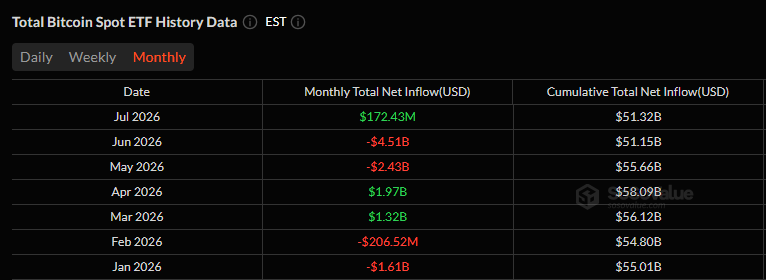
Monthly spot Bitcoin ETF flows in 2026. Source: SoSoValue
Ether and XRP ETFs Are Holding Up Better
While Bitcoin ETF flows struggled to maintain momentum, Ether ETFs delivered a more consistent picture. Spot Ether ETFs posted four consecutive weeks of inflows through July, ending the month with $365.2 million in net inflows — their second positive month of 2026 after April’s $356 million. The products remain about $1.1 billion in net outflows year to date, but the trend through July pointed in the right direction.
XRP ETFs continued their quiet outperformance, recording $27.3 million in July inflows and marking their fifth consecutive positive month of 2026. With $343 million in net inflows year to date, XRP ETFs have proven to be one of the more resilient crypto ETF categories this year — a result that would have surprised most observers at the start of 2026.
The cumulative picture for Bitcoin ETFs remains substantial despite the 2026 struggles. Total net inflows since launch stand at $51.32 billion, with net assets of $76.29 billion at the end of July.
Bitcoin ETF Flows Reflect a Market Still Hostage to Macro
The 2026 Bitcoin ETF flow data tells a consistent story — institutional money enters when macro conditions ease and exits when they tighten, with very little evidence of the long-term, conviction-driven allocation that Bitcoin advocates have long argued ETF approval would unlock. March, April and July were the only positive months, and each corresponded to periods of relative calm in rate expectations or geopolitical risk. January, February, May and June, the months that produced $8.75 billion in combined outflows, each coincided with escalating Iran war tensions, rising oil prices or Federal Reserve rate hike speculation.
The contrast with XRP ETFs is instructive. A product tracking an asset with a fraction of Bitcoin’s institutional recognition has posted positive flows in five of seven months this year. That is not a statement about XRP’s fundamentals, but a statement about who is buying these products. XRP ETF buyers appear to be retail-orientated and less sensitive to macro rotation. Bitcoin ETF buyers are institutional, rate-sensitive, and willing to exit quickly when the environment shifts. That distinction matters enormously for understanding what the ETF approval actually delivered — access for a new class of investor whose behaviour has made Bitcoin more correlated to macro conditions, not less.
