


Tether, the issuer of the world’s largest stablecoin USDT, froze more than $514 million across 370 wallet addresses on the Ethereum and Tron blockchains in the past 30 days alone, according to onchain data from BlockSec’s USDT Freeze Tracker. The overwhelming majority of that activity — $505.9 million across 328 addresses — occurred on Tron, which has become the dominant network for stablecoin-based enforcement actions.
The recent figures build on an accelerating trend. In all of 2025, Tether blacklisted 4,163 addresses and froze $1.26 billion in USDT, according to BlockSec analysis. The current pace suggests that the total will be exceeded well before the end of this year. A broader study covering 2023 to 2025 estimated that Tether immobilised roughly $3.3 billion across 7,268 addresses over that period — far more than rival stablecoin issuer Circle. Tether itself disclosed in February that it had frozen approximately $4.2 billion in tokens over three years, with $3.5 billion of that locked since 2023 as enforcement pressure intensified.
Once frozen, funds rarely move again. Of the $1.26 billion blacklisted in 2025, more than half was subsequently destroyed using the contracts’ built-in “destroyBlackFunds” function. Only 3.6% of blacklisted addresses were later removed from the list.
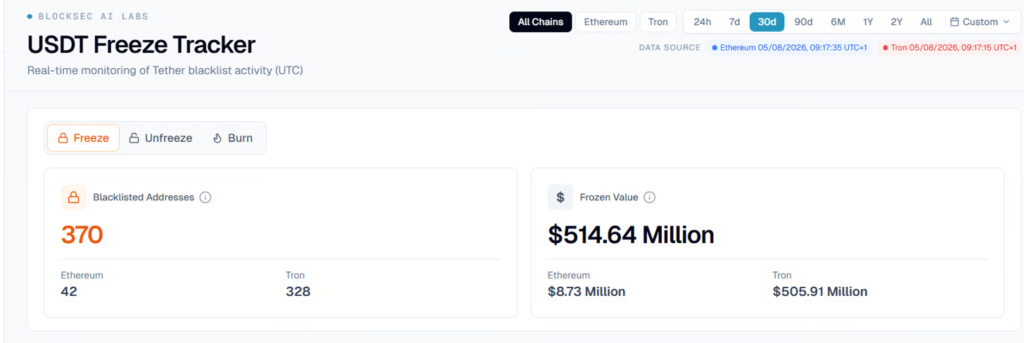
USDT Freeze Tracker. Source: BlockSec
What the Freeze Record Actually Covers
The cases behind these numbers span a wide range of enforcement priorities. In April, Tether worked with the US Treasury’s OFAC to freeze $344 million in USDT across two Tron addresses linked to suspected Iranian sanctions evasion — a case this publication covered when it was announced. In February, Tether helped authorities seize more than $61 million in USDT connected to pig butchering scams, a form of fraud in which victims are manipulated into transferring large sums into fraudulent investment platforms before the funds are stolen.
The concentration of activity on Tron is not accidental. Tron has become the preferred network for moving dollar-denominated value outside the traditional banking system, particularly in regions with limited access to US financial infrastructure. That makes it attractive for legitimate remittance use — and equally attractive for sanctions evasion and fraud.
Tether Is Now a Regulated Enforcement Arm — Whether the Industry Admits It or Not
The debate inside the crypto industry about Tether’s blacklisting powers tends to focus on the wrong question. The concern raised most often is about centralisation. The fact that a private company retaining the ability to freeze and destroy user funds undermines the principles that make crypto valuable in the first place.
Tether is not exercising these powers arbitrarily. It is operating as a de facto enforcement partner for US law enforcement and sanctions authorities, responding to government requests at a scale and speed that traditional financial institutions would struggle to match. $344 million frozen overnight in the Iran sanctions case. $61 million seized in a fraud investigation. $514 million was blacklisted in a single month across hundreds of addresses.
This is what compliance at scale looks like in a stablecoin infrastructure that sits under US jurisdiction. The broader implication for the crypto industry is one I have raised before in the context of the Drift hack and the Iran crypto toll story — the infrastructure that powers decentralised finance is not as decentralised as it appears once you follow the dollar. USDT is the liquidity layer underneath enormous portions of DeFi activity, and the entity that issues it can freeze any wallet, on any supported chain, at any time, in response to a government request. That is not a flaw in the system. For regulators, it is increasingly the feature they are most interested in.
